The best decision Barbara and Declan made all day was to stop the car.
They married at one o’clock in Booterstown, on the south side of Dublin, and their reception was at The Millhouse in Slane, the guts of an hour north. That is the classic Irish wedding shape: a church at one end, a venue at the other, and an awkward stretch of motorway in between that most couples treat as dead time. We treated it as the portrait session, and it changed the whole back half of the day.
A Friday Morning in Dublin
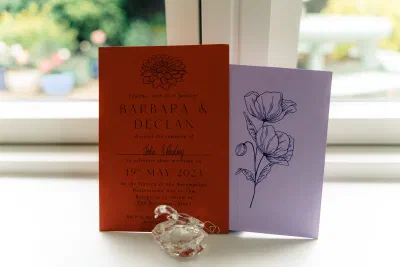
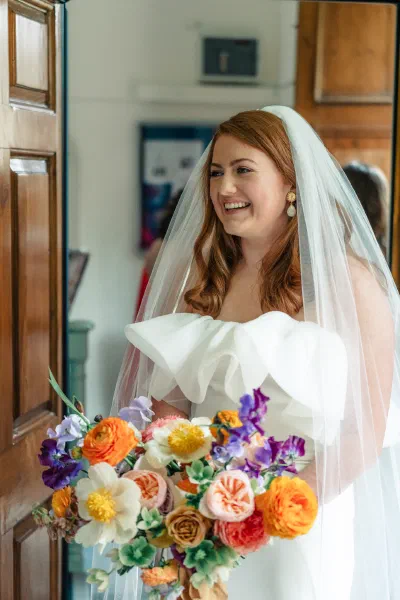
The invitation set the tone before anyone got dressed: burnt terracotta, soft lilac, and line drawn dahlias and poppies. Everything that followed pulled from that, right down to the bouquets.
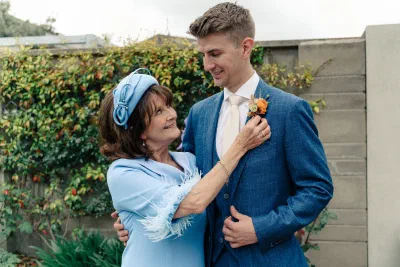
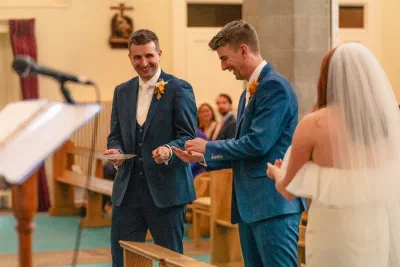
Declan wore a lighter blue check three piece suit and put his groomsmen in plain navy, all of them in cream ties. That is a small decision that pays off in every group photograph for the rest of the day. When a whole party wears the same navy, they merge into one shape and the groom disappears into the middle of it. One textured, lighter suit and the eye knows exactly where to go, without anyone having to be pushed to the front.
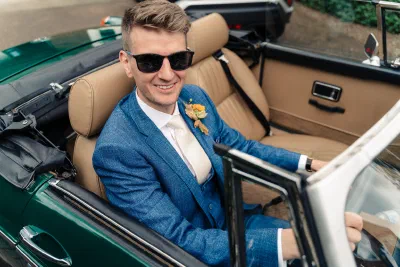
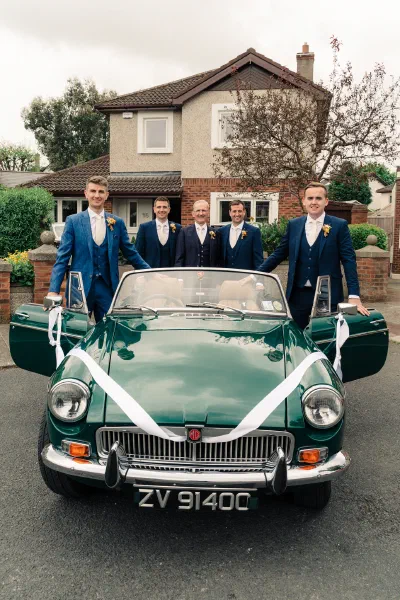
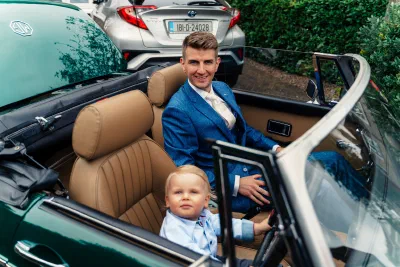
Then the car. A vintage green MG roadster, white ribbon across the bonnet, roof down for a day that stayed dry. I will come back to this, because it did more work in this gallery than any single decoration could.
Booterstown
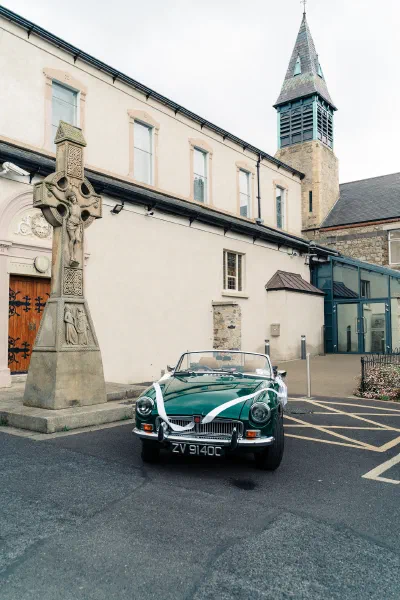
The Church of the Assumption on Booterstown Avenue has a carved Celtic high cross in the forecourt and a slate spire behind it, and if you park a 1960s sports car between the two you have an establishing photograph that tells you the country, the decade and the mood in one frame. I did not arrange that. Somebody parked there and I got lucky.
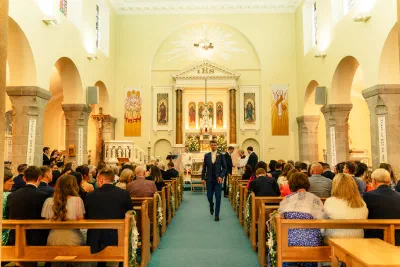
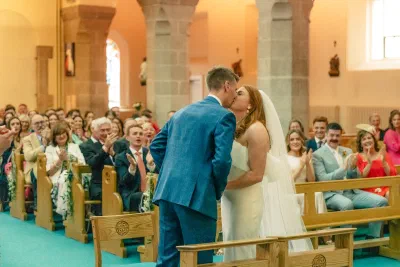
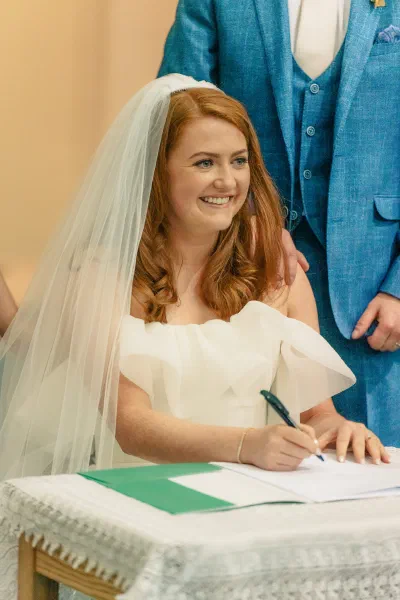
Inside it is warm and bright: pale yellow walls, granite columns, rounded arches, and stained glass set high in the clerestory rather than down at eye level. That last detail matters more than it looks. Light falls from above rather than blasting in behind the couple, so the whole room sits at one even exposure and faces stay lit. Churches are usually the hardest part of an Irish wedding to photograph, because they are dark and you cannot move around during the ceremony. This one is neither.
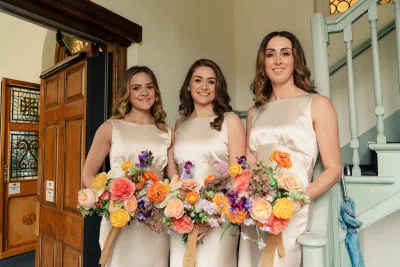
The bridesmaids were in oyster satin, plain and unfussy, which let the bouquets do the shouting: coral, orange, butter yellow and purple, tied with ochre ribbon. Against a neutral dress that reads as a deliberate colour palette. Against a patterned dress it would read as noise.
The Bit In Between
Here is the part worth copying.
Booterstown to Slane is about an hour. The standard version of this day is that everyone gets in a car, drives north, and the couple arrive at the venue in the middle of their own drinks reception, at which point they get pulled away from their guests for forty minutes of portraits.
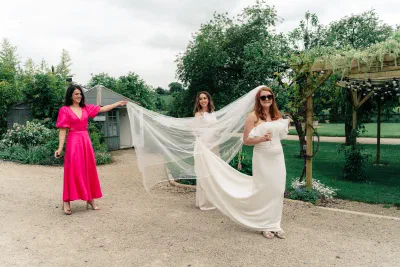
We went the other way. We stopped twice on the road up, for about twenty minutes in total.
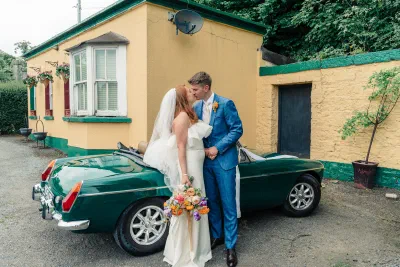
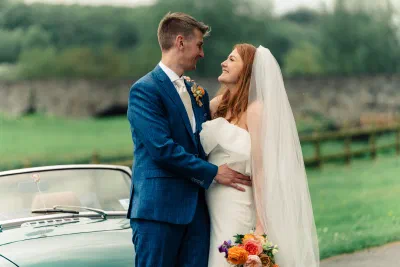
An old stone bridge over the Boyne, green fields either side, and a car that matches the landscape. None of that required a location scout or a permit. It required deciding in advance that the drive was not dead time.
The practical payoff came later: they walked into The Millhouse with their portraits finished, and stayed with their guests for the rest of the evening.
The Millhouse
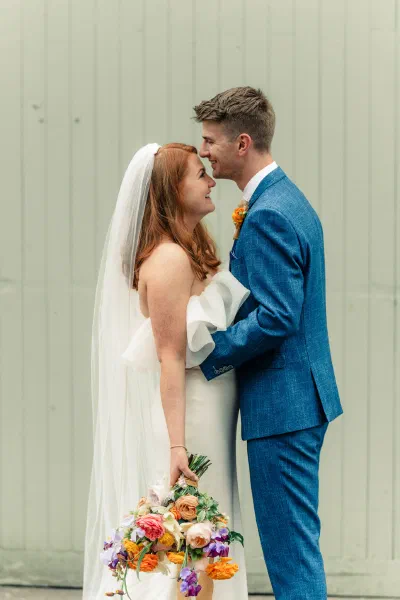
We took ten more minutes on arrival, because the mill buildings hand you backdrops for free. A run of pale painted boards. Old brick. Stone. All within sight of the front door.
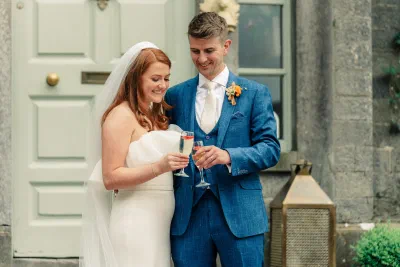
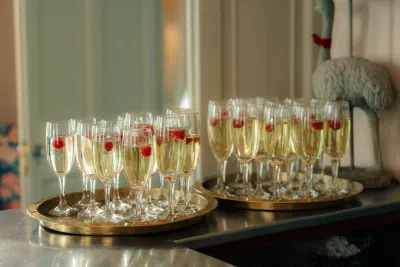
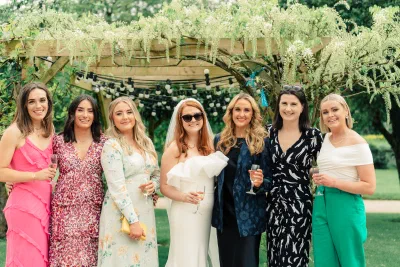
The drinks reception happens outside, in a walled garden and orchard behind the house with a wisteria pergola running along one side. In the third week of May that is about as good as an Irish drinks reception gets. Nobody was herded anywhere. Group photographs happened where people were already standing, with a drink in their hand.
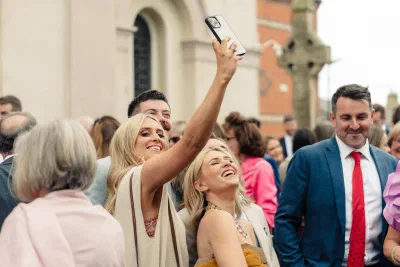
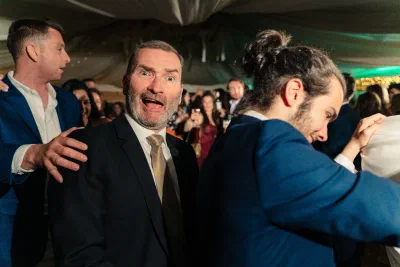
I should mention the guests, because it is genuinely rare: this was the most colourfully dressed wedding I have photographed. Hot pink, tangerine, emerald, cobalt. It gives a gallery an energy you cannot manufacture, and it is worth thinking about if you are the kind of couple who might otherwise ask people to stick to a palette.
The Orangery
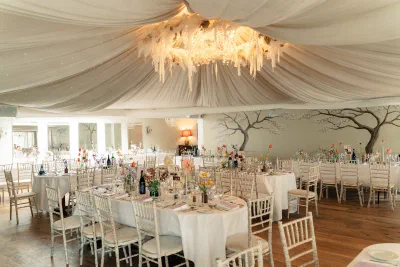
This is the room you book the venue for. A long glass sided orangery with a draped ceiling, chandeliers down the middle and a hand painted tree running along the back wall.
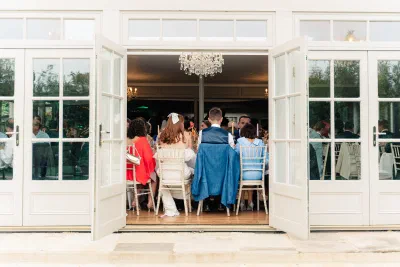
Glass rooms are the best thing that can happen to a wedding photographer. It is lit from both sides all afternoon, so nothing needs a flash and nobody is squinting into a window. Then it turns over completely after dark and becomes a warm box of chandelier light with black glass on both sides.
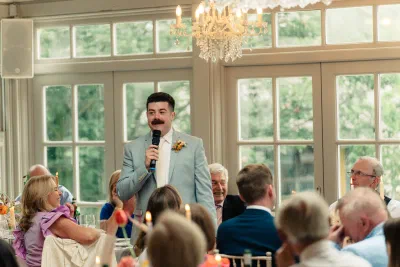
Speeches ran long and the room kept interrupting, which is always the sign of a good one.
The Evening
Planning a Wedding at The Millhouse
That is the day. Here is the practical side, for anyone weighing the venue up rather than just looking at the photographs.
Plan the Transfer, Not Around It
If your ceremony is in Dublin and your reception is in Meath, you have roughly an hour in a car in the middle of your wedding day. You can lose that hour or you can use it.
Using it means picking one or two stops on the route in advance, telling your photographer and your driver, and budgeting twenty minutes. It does not need to be a famous location. A bridge, a stretch of river, a painted wall on the side of a country road. What you get back is the entire drinks reception, because your portraits are already done when you arrive.
The Boyne Valley makes this easy. You are driving through it anyway.
The Orangery Works at Both Ends of the Day
Most venues have one good hour. The orangery has two completely different looks: soft, even daylight through glass in the afternoon, and warm chandelier light against black windows at night.
That matters more than it sounds. It means the room your guests sit in for dinner is also a room you can photograph in at eleven at night without it looking like a different, worse wedding.
A Friday in May
Two things worth stealing here. A May date gives you sunset around half nine, so a one o’clock ceremony leaves the whole day unhurried and the drinks reception outdoors for hours. And a Friday date is usually easier to get and easier on the budget, with no real cost to the day itself.
The Frame Worth Booking It For
Two, at opposite ends. The couple and the car beside the stone bridge on the Boyne, ten minutes from the venue and free to anyone willing to stop. And the orangery photographed from the garden after dark, doors open, chandeliers lit, the whole party visible inside it.
Thinking About The Millhouse?
If you are looking at Meath venues and you want stone, water and a glass room that carries the evening on its own, this one is worth the drive to see. And if you are being told that a church wedding an hour from your reception will eat your day, it does not have to.
There is more on the county, and on the other venues worth seeing in the Boyne Valley, in the Meath wedding photography guide.
Have a look at wedding photography packages or get in touch and tell me about your day.